

Acreage and land
Arlington and Snohomish County Acreage and Land Real Estate
Wells, septic, critical areas, legal lots, access and financing, in one place, with the rural properties on my own record as the examples. For buyers and sellers of land around Arlington, Marysville, Granite Falls, Oso, Darrington and the Stillaguamish valley.

Most of what decides whether a piece of rural land works for you is on record somewhere: the county's zoning and critical areas maps, the Health Department's septic files, the state's well reports, the recorded easements and the title report. The trouble is that it is on record in six different places, and nobody hands it to you in one. This page is my attempt to.
I came to Arlington from British Columbia in December 2003, drove trucks for a living in Snohomish, Skagit, Whatcom and Island counties, and spent almost eight years as a firefighter and EMT with the Arlington Fire Department before I became a broker with Windermere Real Estate Arlington. The case studies below are properties I have actually listed or bought for clients, with the figures as recorded in the NWMLS. Nothing here is borrowed from an office total.
On this page:
- Case studies: 15 acres in two legal lots, 2.30 acres of bare land, and a 6.68 acre hobby farm
- Buying acreage and selling acreage
- Vacant land and legal lots, wells and water and septic
- Critical areas and wetlands, flood zones and access and easements
- Manufactured homes on land and shops and outbuildings
- Family compounds and second homes and dividing land
- Financing land and current use and timber

Case studies
Three rural properties from my own record.
Status and price on the two active listings update from the NWMLS feed.
Active · MLS 2521827
15 Acres, Two Legal Lots, Arlington
21103 252nd Street NE · $849,950
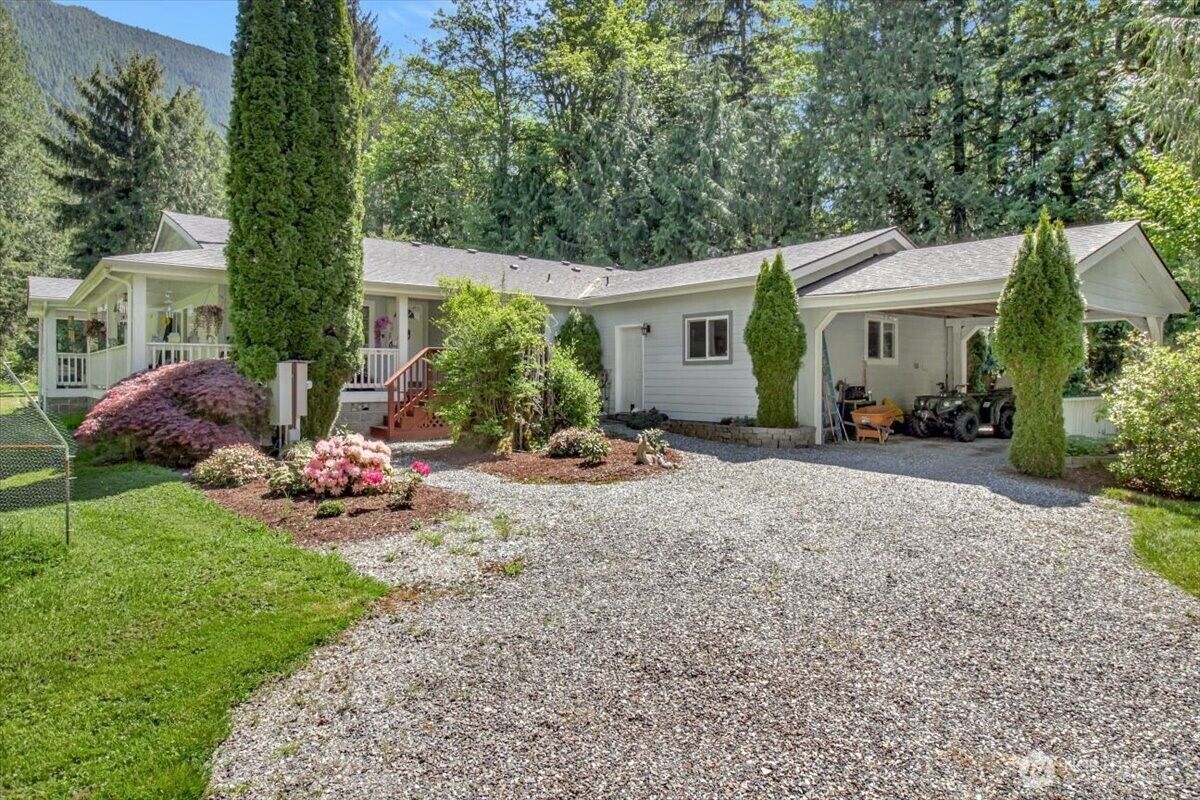
Fifteen acres at the end of a private road. Ten acres carry the home, the shop and the outbuildings, and a separate five acre parcel comes with it. The home is a 3 bedroom, 2 bath triple-wide of 1,797 square feet, built in 2004 on a poured concrete foundation, with a greenhouse, a hot tub and room for the RV.
What makes it unusual. Two legal lots is the story. A second lot is a second set of options, and it is worth far more documented than described. The poured foundation matters too, because a permanent foundation is one of the first things a lender asks about on a manufactured home.
What a buyer should check. The lot status of both parcels on the county's map, the recorded access along the private road, the well and septic records, the permits for the shop, and the manufactured home's title status and foundation paperwork.
Active · Land · MLS 2559090
2.30 Acres of Vacant Land, Arlington Heights
16902 McElroy Road · $350,000
Fully forested ground in Arlington Heights, with electricity available at the property and no sewer. The potential is a future homesite among the trees, a place to use and enjoy, or a long-term land hold, subject to what the county approves.
Why the listing reads the way it does. It tells buyers to verify access, boundaries, zoning, utilities, well and septic feasibility, critical areas and suitability for their intended use. That is not boilerplate. On bare land those are the questions that decide what the parcel is worth to a particular buyer, and the listing leads with an aerial photograph with the boundary drawn on it because where the lines are comes first.
What a buyer should check. With no sewer, a home here needs a septic site evaluation. Water means a purveyor or a well under the Stillaguamish basin rules. Then the zone, the lot status and the critical areas layers on the county's maps, all inside a feasibility contingency long enough to get the answers.

Closed November 2025 · Represented the buyers
A 6.68 Acre Hobby Farm, Bought Before Selling
18010 123rd Avenue NE, Arlington · $647,500
A hobby farm with a fenced animal pasture, outbuildings, a greenhouse, RV parking, a chicken yard with a coop, walking trails from the door, and cleared ground with new soil brought in for gardens. I represented the buyers, and it closed in November 2025.
The other half of the move. The same household still owned a house in Mountlake Terrace. I listed and sold that house four months later, and it closed in February 2026. Buying before selling means carrying both for a while, and it is the order most people end up in when the right rural property turns up first.

Case study 1 of 3

Buying acreage
Start with the records, not the drive. Before you walk a parcel, look it up on the county's SCOPI property map and its zoning map viewer: the zone, the lot status, the critical areas layers and the flood designation. Then get the septic file and the well report, find the recorded access, and ask whether the land is in a current use tax program.
Write the offer with a feasibility contingency long enough to answer what the records leave open. Bare land goes on the NWMLS Vacant Land Purchase and Sale Agreement, and acreage with a home can carry the Land and Acreage Addendum, the Well Addendum and the Septic Addendum. The full checklist is in Buying Land and Acreage in Snohomish County, and the property search covers every acreage and land listing on the Northwest MLS.

Selling acreage
Rural property sells on documents. The buyers who can close are the ones who get answers about the well, the septic, the zone and the road before they write, so build that file before the sign goes in: the well report and a current water test, the septic records and the inspection that every sale with septic needs from November 1, 2026, the survey, the easements, the permits and the tax status.
Price against what closed, show the ground with an aerial and a site sketch, and plan the showings around gates and animals. The longer version is Selling Acreage and Rural Property in Snohomish County. If you want a number for your own land, ask for a home value and I will come and walk it.

Vacant land and legal lots
A tax parcel and a legal lot are not the same thing. A parcel number on a tax statement tells you how the assessor bills the land. Whether it can be built on as its own lot is a separate question, and the county's zoning map viewer shows lot status for exactly that reason. Two legal lots, like the 252nd Street NE property above, carry options one lot does not.
The zone sets the rest. Around Arlington you will mostly see R-5 (Rural 5-Acre), RRT-10 (Rural Resource Transition 10-Acre), RD (Rural Diversification), A-10 (Agriculture 10-Acre) and F (Forestry), each with a purpose set out in Snohomish County Code 30.21.025. Whether land is buildable comes down to three things lining up: a zone that allows a home, a water source the county accepts, and a septic system the Health Department approves for that ground.

Wells and water
Before it issues a building permit on rural land, the county wants to know where the water comes from, and the rules depend on the river basin. From the county's exempt well information:
- Stillaguamish basin, which takes in Arlington. If an approved water purveyor can serve the site in a timely and reasonable way, you connect. If not, you need the purveyor's letter saying so, and household use from a new well is generally limited to less than 5,000 gallons a day on an annual average.
- Snohomish basin, which takes in Lake Stevens, Snohomish and Monroe. A new permit-exempt well is limited to 950 gallons a day on an annual average, and 350 in a declared drought, with a document recorded on the title and a $500 fee.
For an existing well, read the well report the state Department of Ecology keeps, then pay for a current flow test and water quality test. A shared well needs a recorded shared well agreement.

Septic
Bare land needs a site evaluation by a licensed designer, reviewed by the Health Department, before anyone can say a septic system will work there. A property with a system already has a file in the Health Department's online septic records.
From November 1, 2026, every sale of a property with septic in Snohomish County needs an inspection by a certified professional first, the tank must be pumped if the inspection calls for it, and the inspection can be done up to a year before closing. The details are in The Septic Rule Starts November 1.

Critical areas and wetlands
The county's maps carry layers for wetlands, streams, steep slopes and landslide hazard areas, and most come with buffers where building is restricted. On a small parcel a stream or wetland buffer can take up a large share of the usable ground. The maps are a screening tool, not a final answer. If a layer touches the land, a critical areas study by a qualified professional during the feasibility contingency is money well spent, and on a seller's side it is a question worth answering before listing.

Flood zones
Along the Stillaguamish and its forks, much of the valley floor is mapped floodplain. A home in a mapped special flood hazard area with a federally backed mortgage needs flood insurance, and new building there comes with extra rules. Check the flood designation on the county map before you fall for a river property, and get an insurance quote during the feasibility contingency rather than after closing.

Access and easements
Legal access means a public road or a recorded easement, and a lender will want to see the document. A gravel drive across a neighbour's land that has "always been used" is not the same thing. Where several homes share a private road, look for a road maintenance agreement that says who pays for gravel, grading and snow. The exceptions in the preliminary title report are where easements, covenants and old agreements show up, so read them. And ask Snohomish County PUD how far power has to come, because power at the road and power at the building site are not the same on a long parcel.

Manufactured homes on land
A manufactured home on its own land works well when three things line up: it was built to the HUD code on or after June 15, 1976, its title has been eliminated under RCW 65.20 so the home and land are one piece of real property, and it sits on a permanent foundation. When they do, FHA, VA, conventional and USDA programs can all come into play under their own rules. When they do not, the pool of buyers who can finance it shrinks.
State law under RCW 36.01.225 keeps a county from regulating the placement of a manufactured home more strictly than a site built home, though it can require a new home on a permanent foundation. Everything else is in Manufactured Homes on Land in Snohomish County.

Shops and outbuildings
A shop can be a big part of a rural property's appeal, so its paperwork matters as much as its size. Buyers and lenders ask whether the shop, the barn and any addition were permitted. An unpermitted building does not stop a sale, but it changes the price and the buyer's loan options, so it gets disclosed and priced rather than hidden. If you plan to run a business out of a shop, the zone decides what is allowed, and adding plumbing ties the building into the water and septic questions above.

Family compounds and second homes
If the goal is more than one home on the same ground, there are a few different ways it can work:
- Two legal lots. Each lot can be looked at for its own home, each with its own water and septic answer and subject to what the county allows.
- An accessory dwelling unit. Snohomish County allows ADUs on many rural lots, subject to the zone, the lot size, the water and the septic capacity, and those rules have changed recently, so check the current code for the specific parcel.
- A temporary dwelling for a relative. The county allows a manufactured home accessory to an existing residence as temporary living space for a relative who needs continuous care because of advanced age or infirmity, approved one year at a time with annual renewal, as described on the county's temporary dwellings page.
Whichever route, confirm it with Planning and Development Services for the specific parcel before you buy on the strength of it, or before you market it as a feature when you sell.

Dividing land
Whether land can be divided starts with the zone's minimum lot size and the lot's current status, then runs through survey work, county review and fees. A short plat is not quick, and it only pays when the zone allows it and buyers want the pieces more than the whole. For many sellers the better move is to sell the whole parcel with the division potential documented, and let a buyer pay for the option. Buyers should treat "can be split" in a listing as a question for the county, not a fact.

Financing land
The four common loan types are built to finance a home, not bare ground. Buying land usually means a land loan from a local bank or credit union, a construction loan that covers the build, seller financing or cash, and land loans generally ask for a larger down payment and a shorter term. Acreage with a home can use a mortgage, but the lender will look hard at the well, the septic, the access and, for a manufactured home, the title and foundation. Talk to a lender who does land before you make an offer. If you are buying before you sell, as the hobby farm buyers above did, read Bridge Loan and How Does It Work.

Current use and timber
A lot of acreage is enrolled in a current use program, taxed as farm and agricultural land, timber land or open space rather than at market value. At a sale, the buyer either signs a notice of continuance or the classification comes off and the additional tax comes due under RCW 84.34.108: the difference for the last seven years for open space and timber land, or four years for farm and agricultural land removed on or after September 1, 2025, plus interest and possibly a penalty.
Logging is regulated by the state Department of Natural Resources, and land that is logged and converted to another use without that being handled properly can face a moratorium of up to six years on building permits and subdivisions under RCW 76.09.460. If the land was logged recently, ask under what permit.
Listing and closing figures are as recorded in the NWMLS, September 2026; the Portfolio page is the current record. County rules are summarized from Snohomish County's own pages and code as linked above, and state rules from the Revised Code of Washington. NWMLS form names are from the current NWMLS forms library. This is general information about rural property, not legal, tax, lending or engineering advice about any particular parcel. Verify everything with the county and your own professionals.

Keep reading
The longer versions, in Good Reads

Arlington WA Real Estate and Moving Guide

Manufactured Homes on Land in Snohomish County

Buying Land and Acreage in Snohomish County

Selling Acreage and Rural Property in Snohomish County

Arlington WA Acreage and Land Realtor

The Septic Rule Starts November 1. If You Are Selling This Autumn, It Already Applies to You.

Looking at land, or thinking about selling some?
Tell me about the property, or call or text me at 425-346-7143. If you send an address or parcel number I will pull the records before we talk. Read my Google reviews, see every listing and closing on the Portfolio, or start with the property search.
New listings
Want new listings in your town as they hit the market?
Pick a town, a price and bedrooms. My home search opens with those homes, and every new one can be emailed to you each morning.